
Hola Everyone!
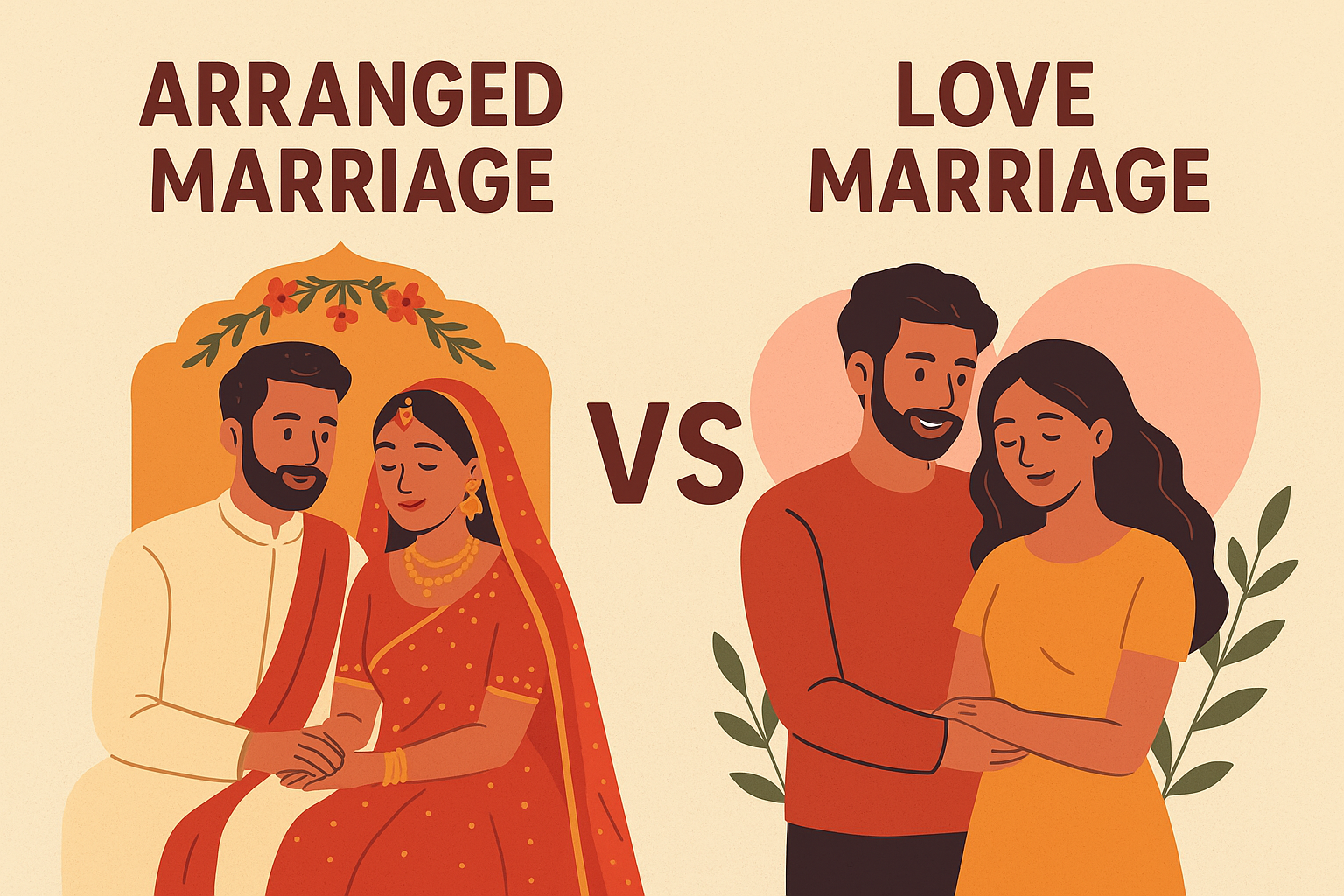
Arranged marriage vs. love marriage—this is one of the most complicated subjects to comment on, or we could say, to discuss. I’ll try to share my opinion on this without being judgmental. You may find my opinion to be wrong in certain places, and I’m open to hearing everyone’s thoughts in the feedback section.
India is known for its cultural diversity, where people belong to various religions, castes, and sub-castes. While many have progressed and adopted a positive mindset, a large number of people remain narrow-minded. In this context, people are often judged based on their religion or caste, which makes supporting love marriages or getting family approval in India equally challenging.
Arranged Marriage: Pros and Cons
You will need to decide the pros and cons, as everything has a flip side.
Family Support – Family support plays a major role in arranged marriages. If there is any problem in the relationship, the family gets involved when things escalate. They sometimes act as mediators, and if the situation worsens to the point of divorce, the individual will have emotional support from their family. In most cases, the family does not blame the individual for a failed marriage or hold themselves accountable for making a wrong choice.
Finding a Partner – The process of finding a partner is unique. Family networks get activated when a member reaches marriageable age. However, background checks are often overlooked, and people rely on the word of some distant family member. I’m not saying this is always wrong, as many good proposals do materialize this way. But sometimes, things can go awry when people lie to cover up toxic family situations, landing the other person in a crisis.
Compatibility – Limited time is often given to get to know a person due to the ‘Jhat Mangni Pat Shaadi’ (quick engagement, quick marriage) philosophy. Some people may treat this as an experience, while others see it as an experiment—and yes, it does work out for many. However, there are cases where toxicity emerges, and one person is left wondering. Women, especially those who work full-time and manage household duties, may face difficulties if their husbands fail to support them.
Example: In my case, I married at the age of 32 due to family pressure, and as usual, it was an arranged marriage. The proposal came through a community marriage group. My father knew someone from my husband’s family who made big claims about him being financially sound, well-behaved, and having a stable job. They also insisted that my family bear the costs of the engagement and wedding, which is typical in our community. I was against this, but my family agreed, assuming he came from a good background.
Post-marriage, I saw a very different picture as I was been told he is in debt. He tried various tactics to make me invest in property, land, a car, or gold—ensuring these investments were in joint names but funded solely by me. He claimed that I didn’t know how to manage finances, which I countered. He forced me to take on 80-90% of household responsibilities, and later pressured me to get large sums of money from my family. His behavior became increasingly disrespectful, and I began to feel like a maid. After 10 months, I left his house and sought my family’s support. Even after we requested financial transparency from him, he refused. Thankfully, my family supported my decision to leave.
As you can see, some people, like me, face significant challenges in making decisions about their own lives. But yes, many do have happy marriages, while others may compromise to avoid societal pressures or for the sake of their children.
Love Marriage: Pros and Cons
Since I don’t have personal experience with love marriage, I’ll comment on what I’ve observed.
Compatibility – Many people take time to communicate, spend quality time together, and even consider living together before marriage. This allows them to understand each other’s nature, character, and career, giving them a better chance to know the person before committing to marriage. However, even with this, there’s no guarantee that the marriage will succeed or fail.
Family Support – While some families in India have become more open to love marriages, many still oppose them. When a person confesses their relationship to their family, they often face opposition. Some are convinced by their families to avoid conflicts, while others marry without family approval and are subsequently ostracized. If the marriage works out, that’s great, but if it doesn’t, many individuals suffer without family support.
You may think I’m reiterating old points, but my point is this: we all must learn to evolve with time and influence those around us. In today’s world, marriage can often feel like a gamble. If there’s no transparency in the relationship—whether it’s keeping secrets, being disrespectful, or lacking support—whether it’s a love or arranged marriage, it’s bound to face difficulties.
Is there really equality between men and women in marriage? No, there can’t be if a woman is expected to be both the provider and the primary nurturer or caretaker. Men shouldn’t expect women to handle everything, as they are humans, not gods. This was the expectation placed on me in my marriage. While some men do suffer, the number is still fewer compared to women.
I urge both men and women to live, learn, and evolve with time to make their marriages blissful.
The opinions I’ve shared above are based on my personal experiences and may differ from others. I hope I haven’t attracted any grudges, but I’d love to hear your thoughts in the comments section.
Have a Nice Day!