
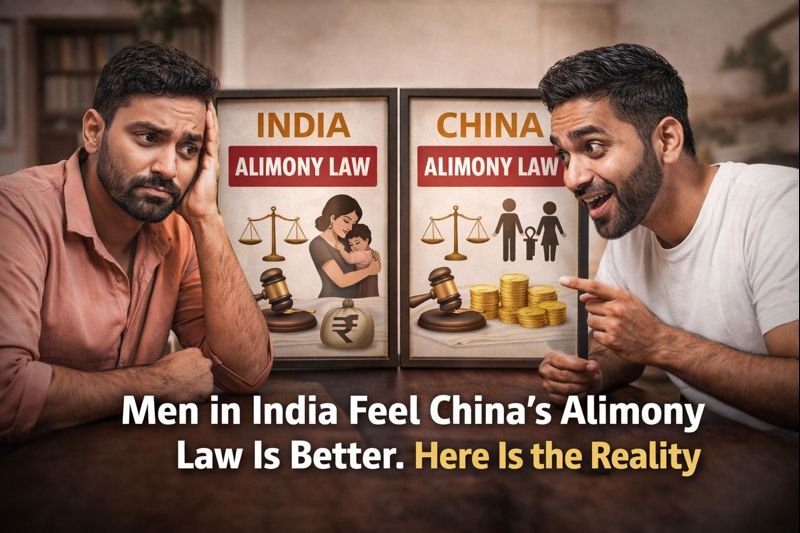
In recent years, there has been a rise in conversations around divorce, alimony, and financial fairness in marriage. Social media has played a big role in amplifying opinions, especially from men who believe China’s new alimony rules are better and “fairer” than India’s.
But before comparing two completely different societies, it is important to understand the ground reality.
India is a marriage prone country, not a divorce prone country. Even today, the divorce rate in India is only around 1 percent, one of the lowest in the world. This means the number of cases that even reach courts for alimony or financial settlement is very small compared to the total marriages happening every year.
At the same time, Indian society is still deeply influenced by traditional expectations, unequal household roles, and financial dependencies. So it is easy for men to feel the law is biased if they have not looked at the entire picture, especially the sacrifices women make within marriage.
Divorce Rates and Alimony in India
India has a low divorce rate of around 1 percent. But even with this low number, people assume women are walking away with heavy alimony amounts. This is a misconception.
Here are the realities:
1. Limited national data on alimony
India does not have a national database that records how many women ask for alimony or how many receive it.
Most divorce cases are settled privately or through mediation, so there is no fixed percentage that reflects the whole population.
2. Only a minority of divorced women get alimony
Lawyers commonly state that the majority of women do not receive lifelong alimony. Most receive either:
- a small one time settlement,
- temporary maintenance while the case is ongoing, or
- no financial support at all.
Permanent alimony is granted mainly in cases where the woman has no earning ability.
3. Dowry is still a reality
While social media portrays modern marriages as equal partnerships, the numbers say otherwise.
According to NCRB 2023:
- 15,489 dowry cases were filed
- 6,075 dowry related deaths were recorded
Despite laws, dowry continues, especially in rural parts. And although the popular narrative says “women take dowry,” the reality in India is the opposite. It is the bride’s family that still ends up giving dowry or extravagant gifts to groom’s side, not the other way around.
So the belief that women enjoy real financial benefit from marriage does not match India’s lived reality.
Why Some Men Think Indian Law Is Biased Toward Women
There is a major misconception driven by social media: that all women ask for alimony, misuse laws, and take advantage of men.
But most men who believe this ignore these factors:
1. Women lose more financially in marriage
Many women sacrifice:
- career growth
- promotions
- work opportunities
- earning capability
Pregnancy, childbirth and childcare slow down a woman’s professional progress. HR teams often ask married women about future plans, making hiring harder. Maternity breaks reduce income. And when they try to restart their career, many struggle due to biases.
2. Household duties fall on women
A working woman is still expected to:
- cook
- clean
- take care of elders
- manage children
- host guests
- follow rituals
- maintain family reputation
Meanwhile, most men do not face such expectations. This invisible workload never gets calculated during discussions on alimony.
3. Women face pressure from in laws
Even in urban families, many women are expected to:
- come home early
- prioritize in laws first
- be available for family work
- visit his parents often
- but men rarely do the same for her parents
Some families even expect the daughter in law’s salary to run the home, yet forbid her from supporting her own parents.
4. When things go wrong, women suffer more
If a marriage becomes abusive, toxic or incompatible:
- women face judgement
- women are questioned
- women struggle to explain the situation to their own family
- women often have no financial backup
- women cannot easily move out due to societal pressure
So when a judge orders alimony, it is based on practical survival needs, not bias.
Why Men Compare India to China
Many Indian men repeat statements like “China gives fair alimony” because they have seen videos without understanding the full context.
Important facts about China that men do not know:
1. China had bride price traditions
Families of men often paid a bride price to the woman’s family before marriage.
This is the reverse of India’s dowry system.
2. Men had to provide a house
In many Chinese regions, men were expected to buy a house before marriage and put it in the bride’s name.
3. China is updating laws to protect men financially
China’s new laws aim at balancing financial responsibility because men were traditionally the ones paying more at the time of marriage.
This context does not match India where it is still the woman’s family that bears:
- wedding cost
- gifts
- rituals
- jewellery and gold
- social expectations
India’s cultural and economic structures are entirely different.
Why China’s Alimony Model Cannot Work in India
Even today in India:
- many men expect the woman’s family to bear wedding costs
- many groom families call thousands of guests because they do not have to pay
- women take on household work for the entire family
- women contribute financially to running the household
- many men do not have a house of their own
- savings levels are low among young men
- men often hide financial liabilities
- women’s careers are affected after marriage and childbirth
- women’s parents receive no support from her after marriage
Under these realities, expecting China’s model in India is unrealistic.
If a woman loses her earning ability due to marriage and children, and later the marriage breaks, alimony becomes a safety net.
Removing it without fixing deeper societal issues will only push women into poverty.
Conclusion
It is easy to criticize Indian laws when we look only at the man’s side of the story. But marriage in India is deeply unequal. Women take more pressure, more responsibility, more emotional burden and more financial risk.
India is a marriage driven society where women are expected to adjust, sacrifice and hold the family together. So alimony is not a punishment for men. It is a support system for women who often lose years of career growth and stability due to marital duties.
Instead of comparing India to China, it is better to focus on creating equal partnerships.
A fair marriage does not need alimony fights.
It needs transparency, shared responsibilities and mutual respect.