

Ever since the release of the Kannada blockbuster Kantara, audiences everywhere have been asking one question — Who exactly is Panjurli Daiva?
Was he a myth? A local god? Or something far deeper — a divine force still worshipped in the coastal lands of Karnataka?
The world of Daivas shown in Kantara isn’t just folklore. It’s part of an ancient spiritual culture known as Bhoota Aradhane, still practised across Tulunadu — the lush coastal belt covering Mangalore, Udupi, and Kasaragod.
At the heart of this living tradition stands Panjurli Daiva, the boar-faced guardian spirit whose story is as mystical as it is meaningful.
A Boar Spirit with a Celestial Beginning
Long ago, in the celestial gardens of Lord Shiva, a wild boar died. The boar’s orphaned offspring was found by Goddess Parvati, whose heart overflowed with compassion. She took the little one into her arms and adopted the young boar as her own child, raising him lovingly in Kailasa, the divine abode.
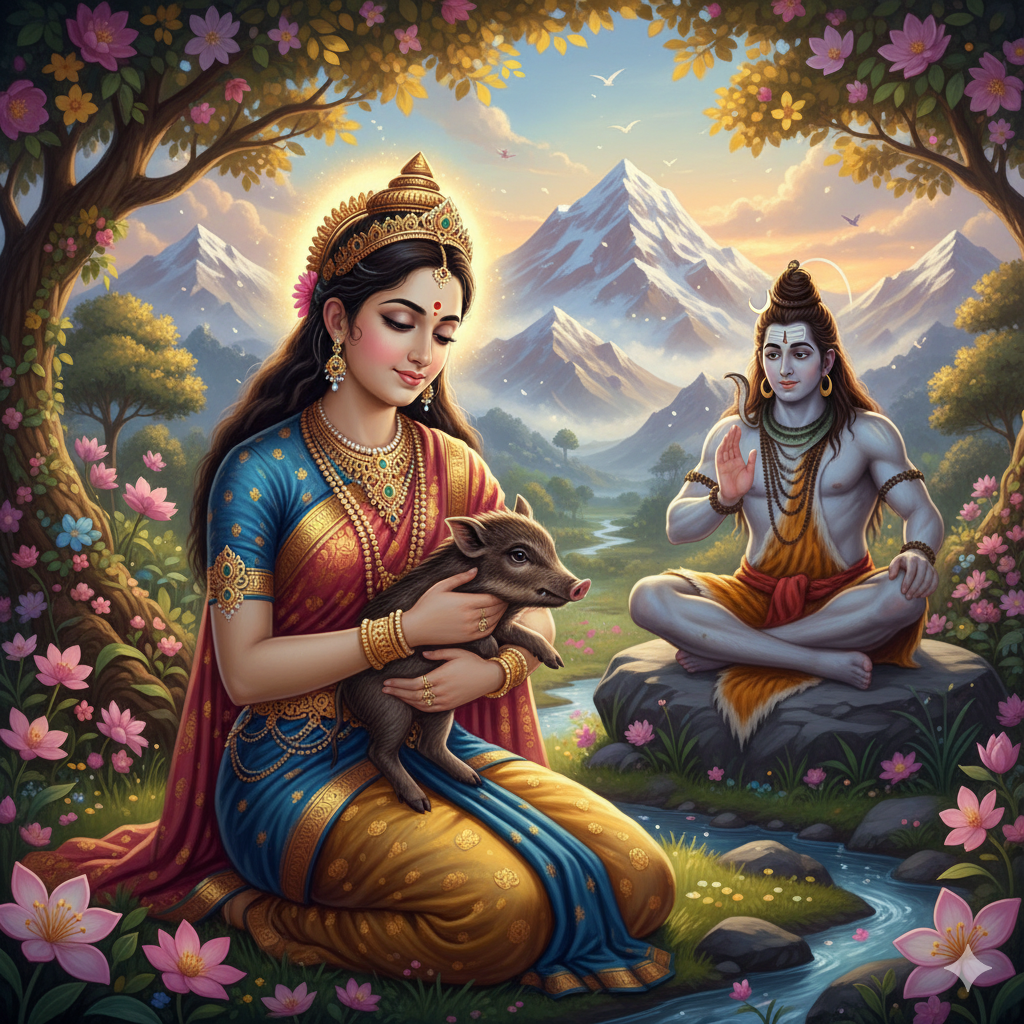
Under Parvati’s tender care, the boar grew strong and spirited. But as he matured, his wild instincts began to surface. He started uprooting trees and disturbing the sacred garden of Lord Shiva.
Lord Shiva, angered by the chaos, decided that the young boar must be punished. But Parvati — filled with motherly love — pleaded for mercy.
Moved by her compassion, Shiva spared the creature’s life but chose a different path. He said:
“You shall be sent to Earth — not in disgrace, but in duty. You will protect mankind, guard their crops, and stand as my divine servant.”
Thus, the boar was banished from heaven but blessed with divine power, becoming Panjurli Daiva, the protector spirit of the Earth.

The Protector of Fields and Farmers
In ancient Tulunadu, farming was life itself. The land fed the people, and the people nurtured the land. But wild boars often destroyed entire crops overnight, threatening survival.
The villagers, who lived close to nature, began praying to the divine boar spirit sent by Shiva and Parvati. They believed Panjurli guarded their fields, kept wild animals away, and ensured good harvests.
Over time, their faith grew stronger. Before sowing seeds or harvesting crops, farmers would invoke Panjurli’s name with offerings of rice, coconuts, and betel leaves. They believed that when the prayers were pure, no wild animal dared to cross their fields.
This bond between faith and farming still thrives. Even today, many families in coastal Karnataka whisper a prayer to Panjurli before they step onto their fields — trusting that the divine protector walks beside them, guarding every grain they sow.
Panjurli and Varaha – The Divine Connection
Some devotees see Panjurli as a reflection of Varaha, the boar incarnation of Lord Vishnu, who lifted the Earth from the cosmic ocean.
Because both deities share the boar form, Panjurli is often seen as a fusion of Vishnu’s strength and Shiva’s justice — a spirit representing the perfect balance between protection and discipline, compassion and correction.
This dual symbolism makes Panjurli not just a guardian of crops but a symbol of cosmic harmony — embodying the eternal rhythm of creation, destruction, and renewal.
The Sacred Bond: Panjurli and Bermer Daiva
In the spiritual world of Tulunadu’s Bhoota Aradhane (spirit worship), Panjurli is rarely worshipped alone. He is often accompanied by Bermer Daiva, also known as Brahma or Bermeru.
Bermer represents creation, while Panjurli symbolizes protection. Together, they uphold justice, balance, and prosperity in the community.
Their worship dates back to around 700–800 BCE, making it one of the oldest living spiritual traditions in South India. In every household and village shrine (Daivasthana), Panjurli is remembered as the fearless guardian who ensures fairness and peace.
The Mesmerizing Bhoota Kola
If you’ve watched Kantara, you’ve already seen a glimpse of the grandeur of Bhoota Kola — but witnessing it in real life is a breathtaking experience.
As dusk falls, the sound of chende (drums) and nadaswaram (wind instruments) fills the night air. The performer — the Panjurli Narthaka — dressed in vibrant red and gold, adorned with heavy ornaments and a boar-faced mask, begins to dance.
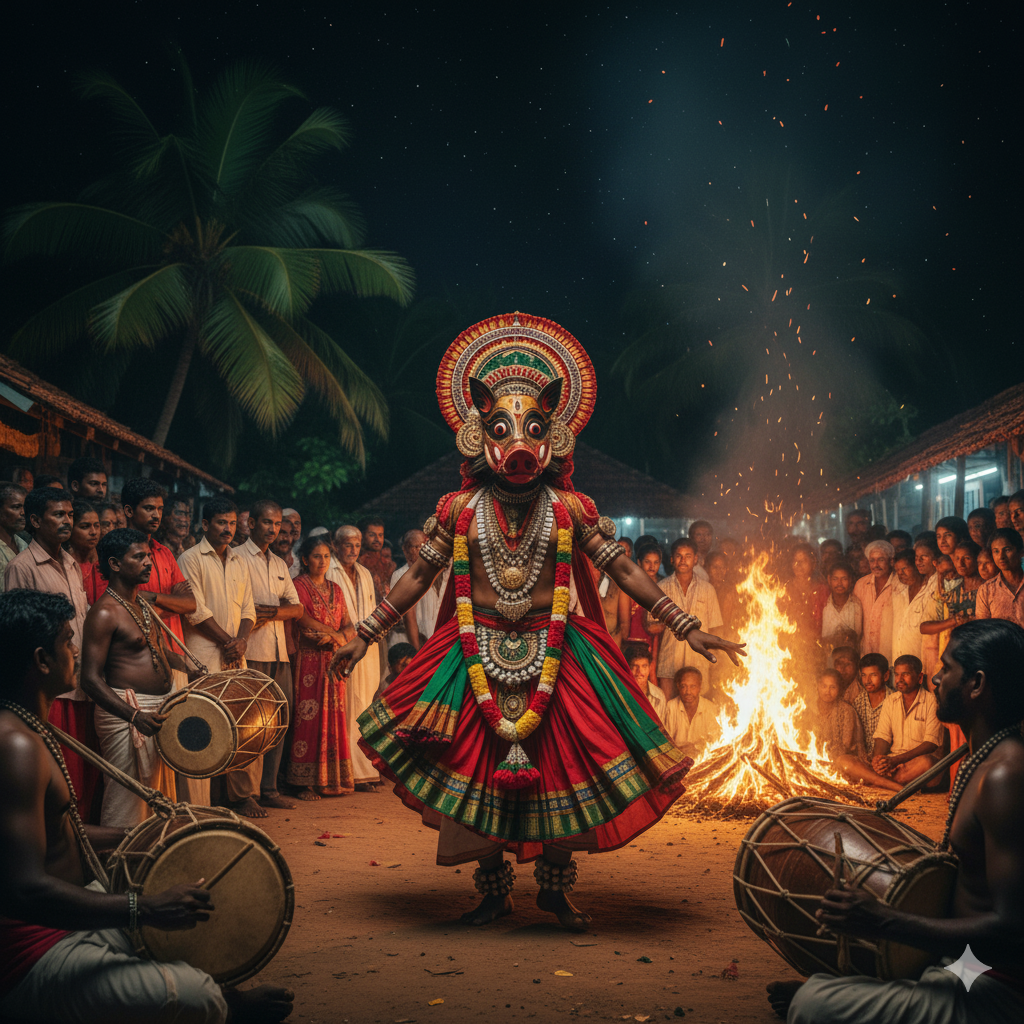
With every beat, the rhythm intensifies. The dancer’s movements grow powerful, his energy unearthly. Soon, his body trembles, his voice changes — and the crowd knows: Panjurli has arrived.
In that sacred moment, the performer is no longer human. He becomes the vessel through which the divine speaks.
Villagers approach him with folded hands — seeking blessings, forgiveness, or justice. The possessed performer, now the embodiment of Panjurli, listens to their woes and delivers divine verdicts.
This is not mere performance. It is faith in motion — a dialogue between humans and the divine that has continued unbroken for centuries.
How the Prayers Take Place
The worship of Panjurli follows an ancient rhythm that connects earth, fire, music, and devotion.
Here’s how a traditional Panjurli Kola unfolds:
- Purification:
The sacred grove (Sthana) is cleaned and decorated with tender coconut leaves, banana stems, and earthen lamps. - Offerings:
Devotees prepare offerings — rice, betel leaves, areca nuts, bananas, and coconuts. These represent purity, prosperity, and gratitude. - Invocation:
The Patri (oracle) and the Panjurli Narthaka (performer) invoke the deity through chants, drumming, and fire rituals. - Descent of the Spirit:
As the rhythm intensifies, the performer enters a trance. The villagers believe that Panjurli’s divine spirit descends into him at that moment. - Blessings and Justice:
One by one, devotees come forward. The possessed performer — now Panjurli — blesses them, settles disputes, and ensures justice.
In earlier times, some families offered animal sacrifices to symbolize man’s harmony with nature. Today, most households have moved to symbolic offerings, keeping the devotion intact while aligning with modern values.
A Story from the Fields
There’s a story the villagers still tell — one that captures the essence of Panjurli’s protection.
A humble farmer once lost his crops year after year to wild boars. One night, defeated and hopeless, he sat under a tree and prayed,
“Panjurli Daiva, protector of fields, if you truly exist, guard my land as your own.”
That night, he dreamt of a glowing boar standing watch at the edge of his farm. When he awoke, he found fresh hoof marks circling his field — but not a single crop was touched.
From that day, no animal entered his land. In gratitude, the farmer built a small shrine to Panjurli and offered a coconut every year. Soon, the entire village followed, and their harvests flourished.
Even today, many such small shrines can be found beside paddy fields in Tulunadu — silent reminders of faith, protection, and gratitude.
Fear, Faith, and Justice
To the people of Tulunadu, Panjurli is not just a protector — he is justice personified.
He rewards honesty, punishes deceit, and restores harmony wherever imbalance arises. During Bhoota Kola, villagers often bring forward disputes — land conflicts, broken promises, or unspoken grievances.
Once the possessed performer, speaking as Panjurli, delivers his verdict, it is considered final and divine. No one dares to challenge it.
For generations, these spiritual judgments have maintained social harmony — guided not by written law, but by divine conscience.
The Symbolism of Panjurli
The legend of Panjurli carries a timeless message.
He began as a creature of chaos but transformed into a protector of peace — showing that even wild energy can find purpose when guided by compassion.
Panjurli represents balance — between destruction and creation, power and humility, man and nature.
His story reminds us that divinity does not exist only in temples or scriptures, but also in the soil, the forests, and in every act of protection and justice.
Panjurli in the Modern World
Thanks to Kantara, the name Panjurli has reached far beyond Tulunadu. People across India — and even abroad — are now curious about these ancient living traditions that survived untouched for thousands of years.
Despite modernization, the spirit of Bhoota Kola continues to thrive. Younger generations are recording rituals, interviewing elders, and preserving stories that were once shared only by the light of fire.
For many, witnessing a real Panjurli Kola becomes a life-changing moment — a meeting of faith, art, and spiritual energy that defies explanation.
The Eternal Guardian
Even today, if you walk through the villages of coastal Karnataka on a quiet night and hear distant drums, chances are — a Bhoota Kola is taking place somewhere.
As flames rise and chants echo through the dark, a fierce yet divine figure appears — half-human, half-boar — blessing the people, protecting their land.
It is Panjurli Daiva — the eternal guardian, still watching over his devotees just as he has for centuries.
He is not a forgotten myth. He is a living spirit, a symbol of faith and justice, and a reminder that the line between human and divine is thinner than we think.
Final Thoughts
Panjurli Daiva’s story is one of compassion, transformation, and balance. From being lovingly adopted by Goddess Parvati to becoming Earth’s protector by Lord Shiva’s command, his journey mirrors humanity’s own — from chaos to consciousness.
He stands as a timeless protector of soil, spirit, and justice — the very heartbeat of Tulunadu’s faith.
So, the next time someone asks, “Who is Panjurli?” you can say —
He is the soul of Tulunadu itself: the boar-faced guardian of faith, the protector of the fields, and the living embodiment of divine balance.
✨ In Tulunadu, there are many more Daivas and countless fascinating stories waiting to be told. I’ll be sharing them in my upcoming posts — so stay tuned! 🙏